


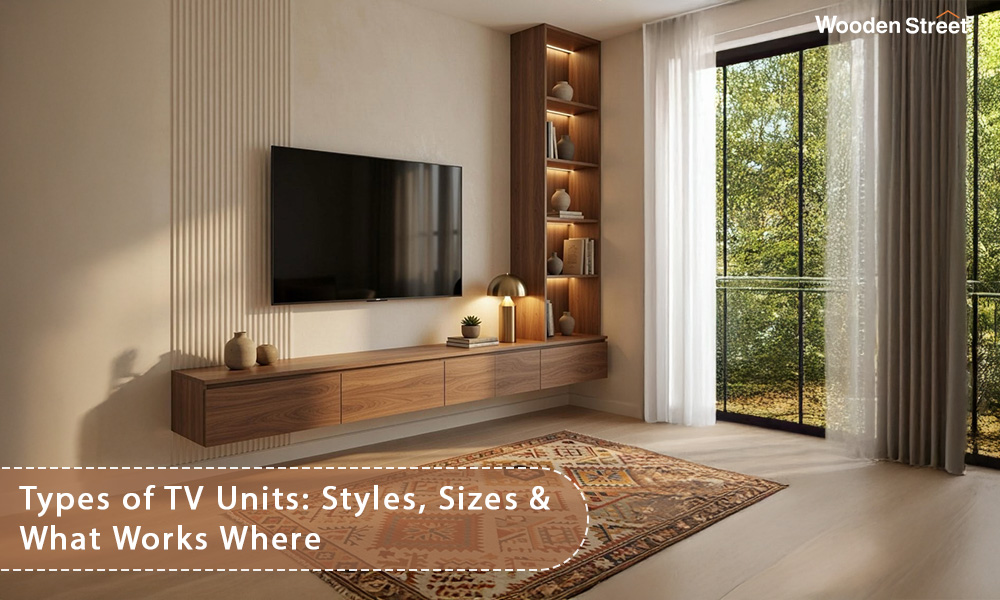



From the trendy cloud couch to practical floor sofa couches, this guide compares comfort, maintenance, durability, and everyday usability for Indian homes. Discover whether a boucle fabric sofa, teddy sofa, cloud sofa, or modern floor sofas can truly handle kids, guests, pets, heat, and daily living without losing style.

Every few months a new sofa style takes over Instagram. First it was the cloud couch. Then boucle everything. Then teddy sofas in every shade of cream and oat. Now floor sofas showing up in every "aesthetic apartment" reel.
They look incredible in the photos. Soft, oversized, expensive-looking. The kind of sofa that makes a room look like it was styled by someone with a very specific taste and no children.
Here's what those photos don't show you. A cloud sofa in a flat without AC in a Delhi summer. A boucle sofa six months after a toddler has been using it as a snack surface. A teddy sofa in Chennai in August. A floor sofa being used as the primary seating by a 60-year-old with a bad back.
That's what this guide is about. Not which sofa looks best. Which one actually works in your specific home, with your specific family, in your specific climate.
Almost every trending sofa style right now originated in European or North American interiors. Cloud sofas became popular in Scandinavian and American interior design circles. Boucle fabric had a resurgence in French and British decorating. Teddy sofas were a Scandinavian winter living staple. Floor sofas came from Japanese interior philosophy applied to Western minimalist spaces.
All of these contexts have one thing in common: they are not India.
European summers reach 25 to 28 degrees and are considered a heat emergency. Indian summers routinely hit 38 to 45 degrees across large parts of the country. European homes rarely have the humidity levels that Mumbai, Chennai, Kochi, or Kolkata deal with for months at a stretch. And European households don't contend with the dust levels that most Indian cities generate year-round.
When a sofa style is designed for and photographed in those conditions, the properties that make it beautiful in those conditions are the same properties that create problems in ours. Understanding that gap is the whole point of this comparison.
The three variables that actually determine whether a sofa survives Indian living are these. How the foam and fill behave in heat above 30 degrees. How cleanable the fabric is in a household with daily use, cooking smells, and dust. And how the structure holds up in high humidity over three to five years.
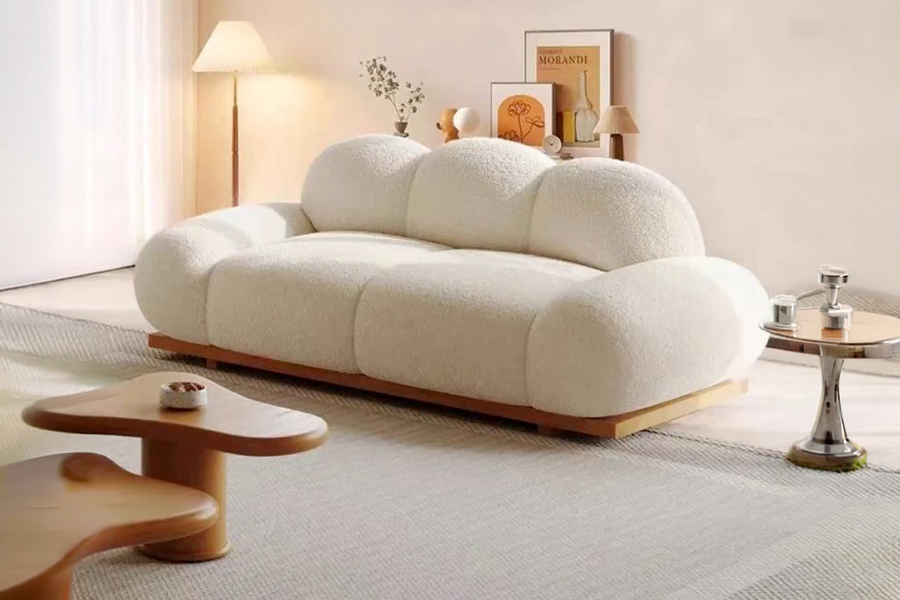
The cloud sofa gets its signature look from three things working together: a deep seat that almost swallows you when you sit down, high-loft cushion backs that are oversized relative to the frame, and fill material that is soft enough to deform significantly under body weight and then spring back when you stand up.
The fill is where the important differences are. True cloud sofas use feather-down fill or a feather-down blend. Some mid-range versions use memory foam. Some use high-density HR foam with a soft top layer. These three materials behave very differently in Indian conditions.
Memory foam is the fill type to be most cautious about. Memory foam is temperature-sensitive by design. It softens in warmth to conform to your body shape, which is the property that makes it comfortable in a temperate climate. In temperatures consistently above 30 degrees Celsius, it softens more than it's supposed to. Cushions that should hold their shape and bounce back start to take a permanent set. The "cloud" shape that looked so good in the showroom starts to look like a deflated cloud within 18 to 24 months in an Indian home without consistent air conditioning.
This is not a brand quality issue. It's a material property. Memory foam behaves this way in heat regardless of who made it.
Feather-down fill has different problems in India: humidity absorption. Down that gets humid flattens and takes longer to loft back up. In a coastal city during monsoon months, a feather-down cloud sofa in a room that isn't consistently air-conditioned will feel noticeably flatter and less supportive than it did when it arrived.
High-density HR foam with a density rating above 40 kg per cubic metre is the most climate-resilient fill option for a cloud couch in Indian conditions. It doesn't give you the full memory-foam softness but it holds its shape significantly better across temperature ranges. Ask specifically: what is the foam density, and is it HR foam or memory foam? If the seller doesn't know the answer, that tells you something too.
Households with a consistently air-conditioned living room. Adults only, no children who will jump on it, spill on it, or treat it as a gymnastics surface. Buyers who think of sofa sets as something to replace every four to five years rather than a fifteen-year investment. If all three of those describe you, a cloud sofa is a genuinely wonderful piece of furniture. If one or more doesn't, read the next sections carefully.
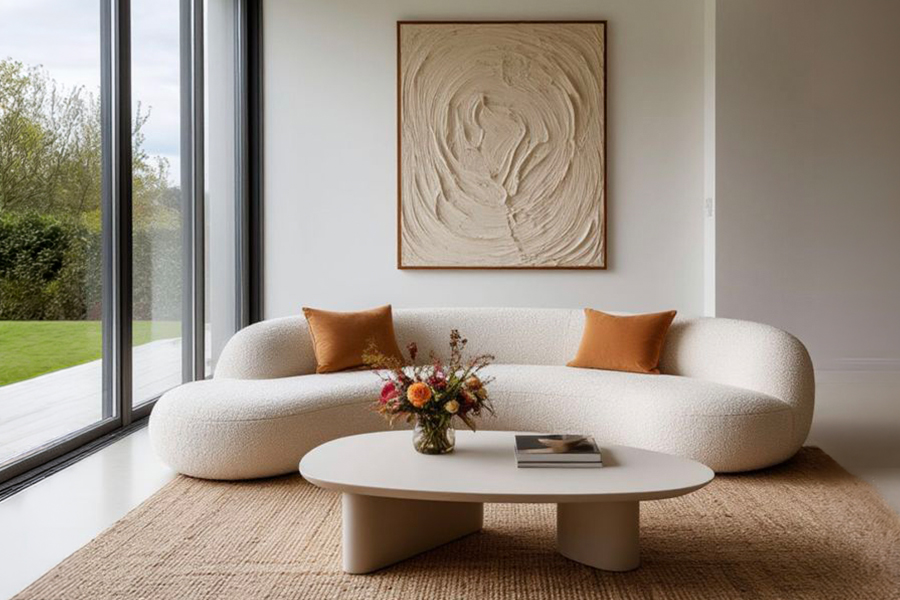
Boucle is a looped yarn fabric. The texture comes from small loops of fibre that sit proud of the surface, creating the nubbly, tactile quality that photographs so well in natural light. It's warm-looking, interesting up close, and has a sculptural quality that flat-weave fabrics can't replicate.
Those same loops are also why a boucle fabric sofa is one of the most demanding fabrics to live with in a real Indian household.
Loops catch things. Pet hair locks into the loops and is genuinely difficult to remove with a standard vacuum. Food crumbs fall into the gaps between loops and sit there. Dust, and in Indian cities there is always dust, settles into the texture rather than sitting on the surface where it can be wiped off. A flat-weave fabric sofa that you can wipe down in thirty seconds requires fifteen minutes of careful attention on boucle to achieve the same result.
Boucle begins to pill, those small fibre balls that form on the surface with friction, within six to twelve months of heavy use. Heavy use means what happens on a family's primary sofa: someone sitting in the same spot every evening, fabric rubbing against clothing with every shift in position, kids and pets moving across it regularly.
Pilling doesn't ruin the sofa structurally. But it changes the look significantly. The crisp, textured appearance in the showroom starts to look worn and fuzzy in a way that isn't the same thing as "worn-in character." It just looks tired.
Spot cleaning with a dry or barely damp cloth is what most manufacturers recommend. No steam cleaning. No wet cloth rubbing. No standard upholstery cleaning spray applied directly. Water applied to boucle can cause the loops to shrink or distort unevenly, creating permanent texture changes in the cleaned area.
For families with children or pets, this cleaning limitation is a deal-breaker in practice. Not in theory. In practice. The first serious spill will happen within weeks of the sofa arriving. What do you do with a glass of juice on a boucle surface that cannot be wet-cleaned? The answer, in most cases, is very carefully try to blot it out and hope for the best.
Adult-only households. Formal drawing rooms that see guests occasionally rather than daily lounging. Low-traffic spaces where the sofa is more of an aesthetic statement than a functional seating surface. If your living room is genuinely the formal room and your family actually uses a separate TV unit room or family room for daily life, a boucle sofa in the formal space can look extraordinary and survive well.
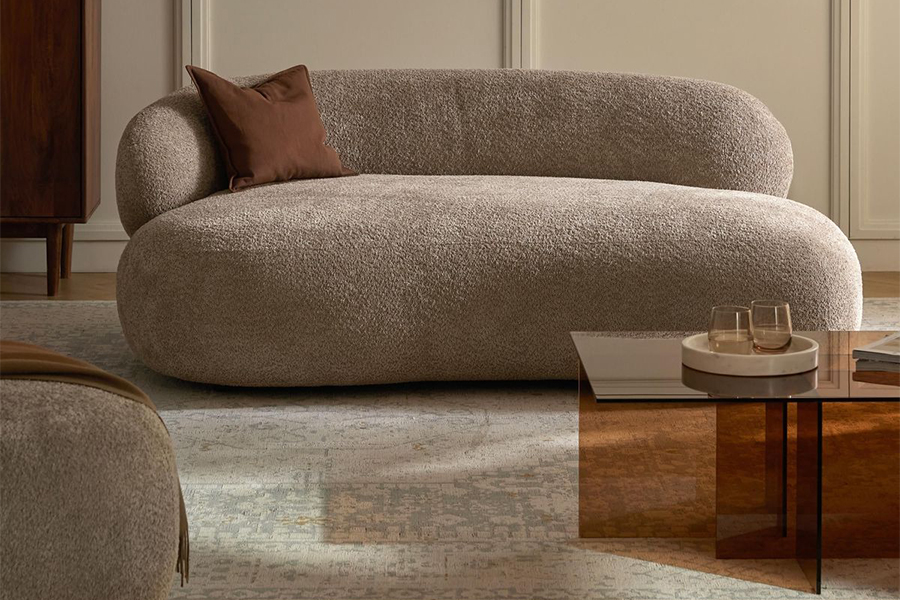
The teddy sofa gets lumped in with boucle because they photograph similarly. Both have a soft, textural, slightly sculptural fabric quality. But the underlying material is completely different and the practical implications of that difference are significant.
Teddy fabric is a synthetic plush, typically a polyester microfibre. The soft, slightly fuzzy texture comes from cut fibres rather than loops. This makes it genuinely more cleanable than boucle because there are no loops to trap debris. A damp cloth works on most spills. Standard upholstery cleaning methods are safe. Pet hair can be removed with a lint roller rather than requiring careful extraction from loops.
For families who love the look of a textured, soft-touch sofa but have children, pets, or both, a teddy sofa is a more honest choice than boucle. It gets you most of the aesthetic with significantly more forgiving maintenance.
Plush synthetic fabrics retain heat. Sitting on a teddy sofa in a room without air conditioning during an Indian summer is uncomfortable in a way that a cotton or linen fabric sofa is not. The fabric warms up with body heat and doesn't dissipate it. In a non-AC room in May or June, this becomes a real factor in whether anyone wants to sit on it.
If your living room has consistent air conditioning, this is less relevant. If it doesn't, or if you're in a city where AC use is seasonal, the heat retention of plush fabrics is worth thinking about before committing.
Lighter teddy sofas, cream, oat, beige, ivory, the colours that make the Instagram photos look the way they do, show staining quickly in high-use environments. The soft plush fibres absorb liquid stains differently from a darker colour, and the light background makes any residual staining visible even after cleaning.
If you have children, if you drink tea or coffee on the sofa, if anyone in the household is likely to eat anywhere near the living room, go darker. A charcoal, deep grey, forest green, or chocolate brown teddy sofa survives real-life use in a way that cream simply doesn't.
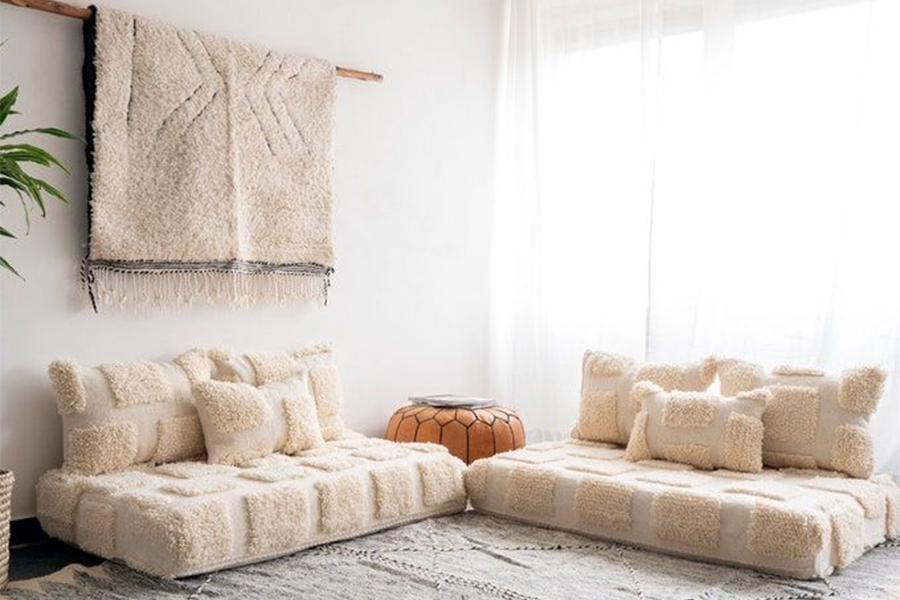
Floor sofas have a fundamental ergonomic limitation that their photography never communicates. They have no lumbar support.
A standard sofa holds your lower back at roughly the angle your spine needs for comfortable extended sitting. A floor sofa, sitting 10 to 15 inches off the ground rather than the standard 17 to 19 inches, puts your hips below the level of your knees when you sit upright. Your lower back rounds. The position is comfortable for twenty to thirty minutes. Beyond that, for most adults, lower back fatigue starts to build.
This is not an issue of quality or construction. It's geometry. A lower seating surface without lumbar support produces a seating posture that the human spine does not find comfortable for extended periods.
For elderly family members or anyone with existing back or knee conditions, floor sofas as primary seating is a genuine problem. Getting up from a low seat requires significantly more effort from the knees and the hip flexors. What looks casual and relaxed in a photograph is physically demanding for people with joint issues.
Media rooms and home theatres, where you're not sitting upright but reclining against cushions. Children's rooms, where the low height is appropriate for smaller bodies and the floor-level format is naturally playful. Casual entertaining spaces and Japanese-aesthetic rooms where the floor-level living philosophy is carried through the whole space, not just the sofa. As a secondary seating option in a room that already has conventional seating.
As the only seating in a primary living room used by a mixed-age household that includes elderly family members, floor sofas are not a practical choice.
A carpet sofa is essentially a floor sofa couch with flat-woven or rug-texture upholstery rather than foam-backed fabric. The texture references a dhurrie or kilim rug aesthetic and the cleaning is straightforward compared to boucle, most carpet-texture fabrics handle a damp cloth without issue.
The same ergonomic limitations apply. Flat-woven upholstery doesn't fix the lumbar support geometry. But for a media room or a casual space where you know what you're getting ergonomically, a carpet sofa is one of the more maintainable of the textured sofa options in this list.
Go with a teddy sofa in a dark colour, charcoal, deep olive, navy, dark brown, with HR foam construction. The plush texture gives you the soft aesthetic. The synthetic fibre is cleanable. The dark colour survives real life. The HR foam holds up over years of children treating the sofa as a trampoline.
Avoid: boucle (impossible to clean properly), memory foam cloud sofas (will sag from jumping), light-coloured anything.
A boucle fabric sofa or a cloud sofa with feather-down or high-density HR foam fill works here. The controlled environment removes the main climate-related risks. The lower daily wear and the ability to maintain the sofa carefully makes the more demanding fabrics viable.
Avoid: memory foam fill even in an AC room if the room temperature fluctuates significantly between occupied and unoccupied periods.
Floor sofas or carpet sofas are the natural fit. The reclined viewing posture works ergonomically for the seating position these sofas provide. The casual register of the space matches the floor-level aesthetic.
Avoid: using floor sofas as the only seating if elderly family members use the room regularly.
This cuts across all the categories above. Mumbai, Chennai, Kochi, Vishakhapatnam, Goa. In these climates, avoid memory foam fill in any sofa style, cloud or otherwise. Memory foam that absorbs humidity doesn't spring back the way it should. Feather-down fill that gets humid flattens and smells over time if it can't dry fully.
HR foam is the most humidity-resistant fill available in the mid-to-high price range. If you're in a coastal city, ask specifically about foam construction before any sofa purchase regardless of the style.
The sofa styles in this guide are all genuinely beautiful. That's not the debate. The debate is whether the conditions that make them beautiful in a European living room photograph transfer to your specific home in your specific city.
A cloud couch in a consistently air-conditioned drawing room in Pune or Bangalore can be an excellent long-term purchase. The same sofa in a non-AC flat in Nagpur in summer is a different story. A boucle sofa in a formal room that sees guests on weekends can hold its look for years. The same sofa as the primary seating in a household with two children and a dog will not.
The formula is straightforward: match the sofa's material limitations to your actual living conditions, not to the conditions in the photograph where you first saw it.
The rest is just choosing the colour you love.
We will be back with the next blog soon. Till then, stay tuned!
Image Source: Pinterest, Google, and Wooden Street
Read More -
Top 10 Budget-Friendly Sofa Cum Beds for Small Apartments
Articles you will love to read
Discover 30+ interior design ideas to elevate your home with modern aesthetics and smart functionality. From stylish living room makeovers to creative space-saving solutions, explore trendy and budget-friendly inspirations to revamp your space effortlessly with Wooden Street’s expert design collection.
Continue Reading
Explore vibrant orange colour combinations that suit every space and are perfect for adding warmth and energy to your furniture. Find smart yet stylish orange furniture ideas for every interior.
Continue Reading
Explore blue colour combination ideas for living rooms, bedrooms, and kitchens. From a blue sofa set to cupboards, pair shades with white, gray, yellow, or turquoise for stylish interiors.
Continue Reading
Kitchen colour as per Vastu Shastra plays a vital role in balancing energy and ensuring health, wealth, and harmony at home. This blog explores the most auspicious colour combinations to make your kitchen vibrant, positive, and aligned with prosperity.
Continue Reading
Find smart home renovation ideas, from kitchen makeovers to sofa renovation, and transform your house with stylish, functional, and budget-friendly upgrades.
Continue Reading