




Explore the real pros, cons, durability, and maintenance of mango wood furniture in this honest guide. Learn why mango tree wood furniture, mango hardwood furniture, mango tables, mango stools, mango wood beds, and mango dining tables are becoming popular choices for stylish and sustainable homes.
Every mango wood blog says the same three things. Sustainable. Durable. Beautiful grain.
All of that is true. It's also what every seller says about every wood they're trying to move. It tells you almost nothing useful about whether mango wood furniture is the right choice for your specific home, your climate, and what you're actually building or buying.
So this guide is going to be different. We're going into the mechanical properties, the actual hardness numbers, how the wood moves in Indian climate conditions, why staining mango wood is trickier than most people tell you, and where it genuinely outperforms more expensive options versus where you'd be better off choosing something else.
Start to finish, this is what the furniture industry knows about mango wood but rarely bothers to explain.
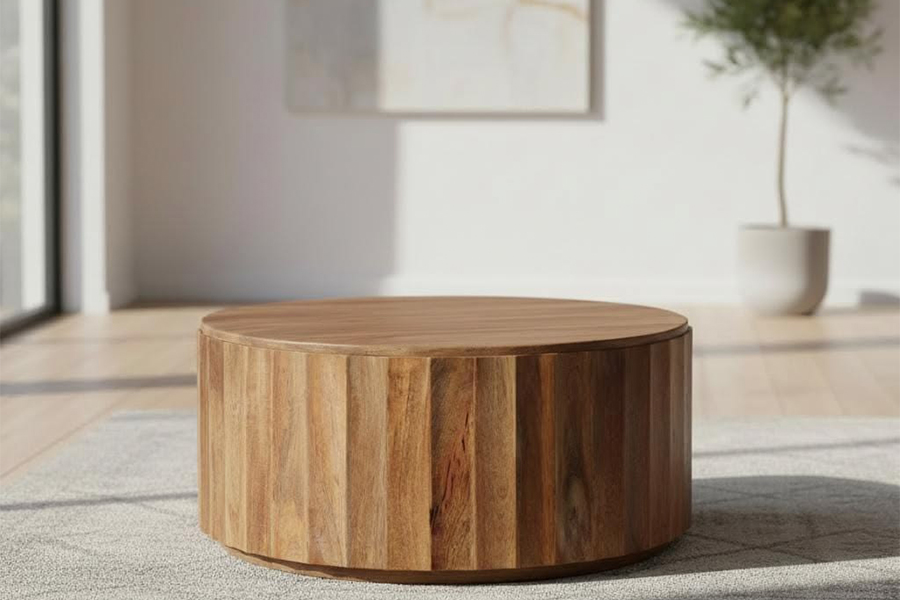
Mango tree wood furniture has an origin story that's genuinely different from most timber, and it matters for reasons beyond marketing copy.
Mango trees bear fruit productively for roughly 18 to 25 years. After that, yield drops off significantly. From a farming perspective, the tree has done its job. In most agricultural contexts, that means the tree gets cleared to make room for a new planting cycle.
Before the furniture industry started using mango timber in a serious way, that clearance meant the wood was mostly burned or left to rot. No secondary use. The tree fed its orchard, then it was gone. When furniture makers started harvesting these end-of-life trees instead, the material cost stayed low because the trees were already coming down regardless. The furniture use is genuinely zero-waste in the literal sense. No tree is felled specifically to make a mango wood stool or a dining table. The tree was always going to come down.
India produces somewhere above 40 percent of the world's total mango supply. The orchards are spread across Uttar Pradesh, Andhra Pradesh, Maharashtra, Karnataka, Bihar, and Gujarat. What this means for timber is a supply chain that is almost entirely domestic. Sheesham comes from the subcontinent but the premium grades increasingly come from international sources. Teak, despite being native to South Asia, has much of its commercial supply coming from plantations in Southeast Asia and Africa. Mango timber moves from an orchard a few hundred kilometres away to a workshop. The transport footprint is genuinely low, which is a real environmental point rather than a branding one.
This is something buyers almost never hear about and it actually affects what the finished furniture looks like.
Plantation mango trees grow in managed rows with consistent access to water, soil treatment, and sunlight. The growth is relatively uniform year to year. The resulting timber has a more consistent grain, smaller growth ring variations, and a more predictable finish absorption. Furniture made from plantation mango tends to look more uniform across the surface.
Wild or orchard-edge mango trees grow at their own pace, responding to variable rainfall, soil conditions, and competition from neighbouring trees. The grain in this timber is more irregular, more figured, more unpredictable. In some pieces this produces extraordinary visual results, the ripple patterns and fiddle-back figuring that make a dining table genuinely one of a kind. In others it produces inconsistency that's harder to work with.
Neither is strictly better. Plantation mango is easier to finish predictably. Wild-grain mango is where the most visually interesting pieces come from. Knowing which you're looking at helps you understand why two mango pieces from different sources look so different from each other.
Janka hardness measures the force required to embed a steel ball halfway into a piece of wood. It's the closest thing the industry has to a standardised dent-resistance score. Here's where the relevant timbers sit:
Mango wood: approximately 1,070 lbf Teak: approximately 1,155 lbf Sheesham (Indian rosewood): approximately 1,660 lbf
What this means practically: mango is slightly softer than teak and noticeably softer than sheesham. It will dent under impact more readily than either. A dropped pan, a chair leg dragged across a mango wood table surface, a sharp edge pressed into it with force, all of these will leave a mark more easily than they would on sheesham.
For a dining table or a bed frame, this difference is manageable. You're not subjecting these surfaces to high-impact stress regularly. For a workbench, a heavily used kitchen surface, or flooring, the hardness gap between mango and sheesham starts to matter more.
The flip side: mango at 1,070 lbf is still meaningfully hard. Pine, which is used widely in furniture globally, sits around 380 to 870 lbf depending on species. Rubber wood, which shows up frequently in budget furniture, is around 980 lbf. Mango is not a soft wood. It's a mid-hardness hardwood that sits comfortably above most of the timber commonly used in value furniture.
Mango wood density sits between 0.65 and 0.75 grams per cubic centimetre. Sheesham runs higher, around 0.85. Pine runs lower, around 0.5. Teak is in the 0.65 range, putting it roughly level with mango.
For everyday furniture this number doesn't make much difference. Where it matters is in large pieces. A mango wood bed in king size with solid wood slats and a carved headboard is a heavy object. Moving it, assembling it in a first-floor flat without a lift, repositioning it during a repaint, all of this is easier with mango than with a sheesham bed of the same dimensions. The wood is lighter without sacrificing the structural properties that make solid hardwood worth choosing.
Wardrobes have the same story. A floor-to-ceiling solid mango wardrobe is lighter than the sheesham equivalent, which matters both during installation and in terms of the stress placed on the floor over years of use.
All wood expands when humidity rises and contracts when humidity drops. Mango's moisture movement is moderate, not extreme, but in Indian climate conditions this is worth understanding before you decide where to put a piece.
In Rajasthan, the air is dry for most of the year with extreme dryness in summer. Wood in this environment is predominantly contracting and the stress is on the finish and the surface rather than the joints. Mango handles this reasonably well when properly finished and oiled.
In coastal cities, Mumbai, Chennai, Kochi, Vishakhapatnam, the situation is different. Humidity swings between the dry season and the monsoon are significant. Wood expands during monsoon months and contracts during the dry months, repeatedly, year after year. Over time this movement puts stress on joints, can cause surface finishes to crack, and in severe cases causes the wood to cup or warp.
Mango is not the most dimensionally stable wood available. Teak, which has natural silica and oils that moderate moisture movement, handles coastal humidity better. If you're in a high-humidity coastal city and you're choosing between mango and teak for a large piece like a mango dining table or a wardrobe, the stability difference is real and worth factoring in. For a city like Jaipur, Ahmedabad, or Delhi, the gap between the two narrows considerably.
This is the one thing almost nobody tells buyers before they order a dark-stained mango piece and then wonder why it arrived looking patchy.
Mango wood has what's called an interlocked grain. Rather than the fibres running in a consistent direction along the length of the board, they spiral and alternate direction in bands across the timber. This interlocking is part of what gives the wood its characteristic visual interest. It's also why finishing mango is more demanding than finishing a straight-grained wood like pine or rubberwood.
The problem with interlocked grain and stain is absorption. Wood absorbs stain through the end grain and the face grain at different rates. In a straight-grained wood this difference is manageable. In an interlocked grain, different sections of the same board face the surface at different angles. Some sections absorb a dark walnut stain heavily. Others, where the grain is running nearly parallel to the surface, absorb almost none. The result is a patchy finish where the stain reads as inconsistent across the same piece.
This is not a manufacturing defect. It's a material property. But it's one that budget finishing doesn't handle well, and it's one that buyers often aren't warned about.
Natural oil finishes and clear lacquers work significantly better on mango than dark stains. An oil finish, danish oil, linseed oil, or a hardwax oil, penetrates the surface and enhances the natural colour variation of the wood rather than trying to impose a uniform colour over it. The result looks intentional. The grain variation becomes the feature rather than the flaw.
Clear lacquer seals the surface without changing the colour dramatically. The wood reads as itself. The natural variation in the mango grain, the warm honey tones, the subtle reddish-brown patches, shows through without the patchiness that a dark stain produces.
If you specifically want a dark finish on mango hardwood furniture, the way to get it without patchiness is through a more involved process: grain filler first, then a tinted sanding sealer, then the stain coat. Quality manufacturers do this. Budget ones don't, and the difference shows.
Figured mango refers to pieces where the interlocked grain produces a pronounced visual pattern on the surface. The two most common figure types are ripple, where the grain produces a regular wave-like pattern across the board, and fiddle-back, where the pattern is tighter and more intense, named after the maple grain traditionally used on the backs of violins.
Figured pieces are rarer and more visually striking than plain-sawn mango. When you see a mango table where the grain has a three-dimensional rippling quality that seems to shift as the light changes, you're looking at a highly figured piece. These come from specific parts of the tree and specific trees. Not every log produces them.
On a practical note: figured mango is harder to finish evenly than plain mango because the surface irregularity is more pronounced. A skilled finisher treats it as an asset. An unskilled one treats it as a problem to cover up.
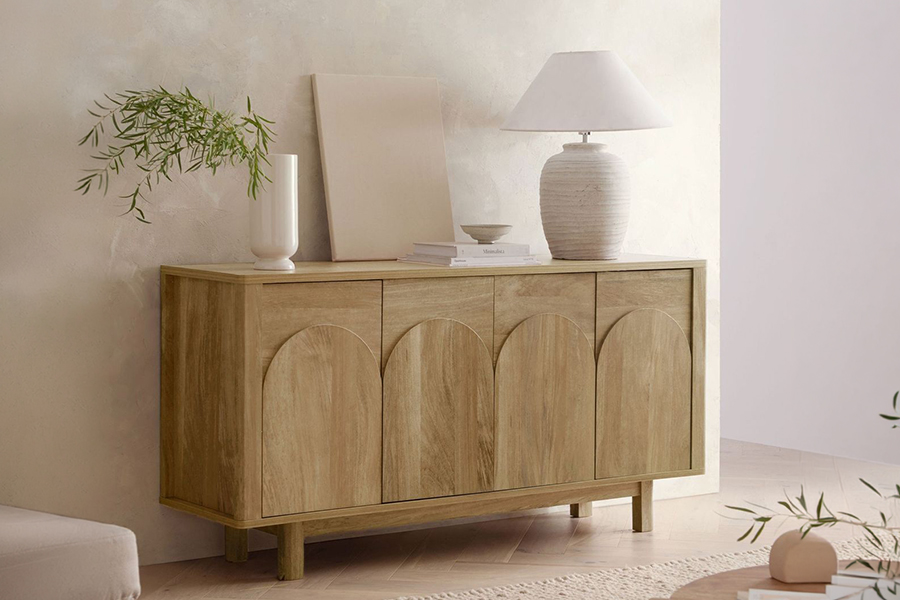
Dining tables are where mango wood is most at home. The surface area shows the grain at its best. The piece isn't subject to high-impact stress in normal use. The size and weight of a mango dining table benefits from mango's lighter density compared to sheesham. And in a dining room context, the warmth of the natural mango finish suits the setting.
Console tables and side tables work well for the same reasons. Grain display, no heavy structural loading, and the visual lightness of mango suits these accent pieces.
Bed frames are a strong application for mango. The headboard is the display surface and mango's grain does that job well. The structural loading on a bed frame is distributed and moderate, well within mango's capabilities. The lighter weight compared to sheesham makes assembly and repositioning easier. A mango wood bed is a genuinely sensible choice for most Indian bedrooms.
Rooms with persistent high humidity. Bathrooms are an obvious example. Kitchens where the wood will be near a sink or a cooking area that generates steam regularly. Mango's moderate moisture stability means it's not ideal in environments where humidity is consistently high rather than seasonally variable.
Outdoor furniture. Mango has no natural teak-like oils that protect it from extended weather exposure. It can be finished for covered outdoor use but it's not a natural outdoor timber and needs significantly more maintenance than teak or acacia in that environment.
Heavy storage applications. A wardrobe or bookshelf carrying significant weight over years benefits from the higher density and hardness of sheesham. Mango will handle moderate loads without issue but for a heavily loaded wardrobe that will stay in place for fifteen years, sheesham's greater hardness and density give it a structural advantage.
For a dining table: mango and sheesham are both excellent choices. Sheesham is harder and more resistant to surface denting. Mango is lighter, often less expensive, and in figured form more visually interesting. If the table will see serious daily use and you want maximum dent resistance, sheesham has the edge. If grain character is the priority and the use is moderate, mango is the better value.
For a bed frame: mango is the better practical choice for most buyers. Lighter, easier to handle, well-suited structurally for the application, and the grain displays well on a headboard. Sheesham beds are outstanding but the weight difference during assembly and any future repositioning is a real consideration in Indian flats without lifts.
For a wardrobe: sheesham or acacia over mango. The structural loading of a full wardrobe with clothes and luggage over a decade is significant. The greater hardness and dimensional stability of sheesham justifies the higher cost here. Acacia is a good middle option, harder than mango, slightly lighter and less expensive than sheesham.
For a console or accent table: mango is the ideal choice. Low structural demand, high grain display, lighter weight, and a price point that makes sense for a secondary piece.
Mango tree wood furniture needs oiling to stay in good condition. The frequency depends on where you live.
In dry climates, Rajasthan, parts of Gujarat, Delhi in the non-monsoon months, oil twice a year. Once before the dry summer heat sets in, once after the monsoon. The dry air pulls moisture
out of the wood and oiling replaces what's lost.
In humid coastal climates, once a year is generally sufficient. The ambient humidity keeps the wood from drying out aggressively. Over-oiling in a humid climate can leave a sticky surface residue that attracts dust.
The oil type matters. Danish oil and hardwax oils penetrate the wood surface and harden slightly as they cure. They protect from within rather than forming a surface film. Avoid vegetable cooking oils, coconut oil especially, which are sometimes suggested as home remedies. They don't cure properly, they go rancid inside the wood over time, and the smell eventually becomes noticeable. Use purpose-made furniture oil.
A wet cloth left sitting on the surface is one of the fastest ways to damage a mango wood finish. The moisture penetrates the finish, lifts it from the wood surface, and leaves a white ring or cloud mark. Wipe up spills quickly. Don't leave damp items, wet glasses, wet placemats, on a mango surface.
Direct AC draft is something very few furniture guides mention and it causes real damage in Indian homes where air conditioning is pointed directly at furniture. A continuous cold dry draft hitting a wood surface repeatedly causes localised moisture loss, which leads to surface checking, small hairline cracks that run along the grain. If your AC unit points toward a mango piece directly, redirect the vent or move the furniture.
Direct sunlight causes uneven bleaching and dries the finish faster than anything else. A mango dining table placed under a window that gets strong afternoon sun will show UV damage on the sun-facing sections within a few seasons. Use a curtain or blind during peak sun hours if the piece can't be moved.
Two methods work reliably for minor surface scratches on oiled mango wood.
The walnut trick: take a raw walnut, break it in half, and rub the cut surface along the scratch in the direction of the grain. The natural oils in the walnut penetrate the damaged surface and the wood dust from the nut fills the scratch slightly. Let it sit for a few minutes and then buff with a dry cloth. For light scratches this works surprisingly well. It's not a repair so much as a disguise but for everyday surface marks it does the job.
The iron-and-cloth method for slightly deeper indentations: place a damp cloth over the dent and press a warm iron onto the cloth for a few seconds. The steam enters the compressed wood fibres and causes them to swell back toward their original position. Don't use high heat and don't hold the iron in place too long. This works best on dents where the wood fibres are compressed rather than cut. If the scratch has actually removed wood fibre, this method won't help and a proper wood filler matched to the mango tone is the next step.
Wooden Street sources mango timber from end-of-life orchard trees within India, which is both the most sustainable sourcing available and the most consistent in terms of grain character and material quality. The finishing on our mango hardwood furniture uses penetrating oil and clear lacquer processes specifically because of the interlocked grain behaviour described above. Dark stains are available where the process supports them. Where they don't, we'll tell you.
Every piece is solid mango throughout, not a mango veneer over engineered wood with a mango-look finish. The grain you see on the surface runs through the piece.
We will be back with the next blog soon. Till then, stay tuned!
Read More -
7 Types of Dining Tables to Transform Your Space
Image Source: Pinterest, Google, and Wooden Street
Trending Products
Top Picks from EveryoneArticles you will love to read

Dining room decor ideas focus on creating a space that is stylish, functional, and welcoming. From lighting and furniture to colors and wall accents, the right design choices can transform your dining area into a warm and inviting space.
Continue Reading
Explore the top 15 dining table sets trending in 2026, featuring modern, space-saving, and elegant designs. From compact sets for apartments to luxurious statement pieces, these stylish picks are perfect for upgrading your dining space and adding comfort, functionality, and charm to your home.
Continue Reading
Planning to upgrade your living space? This guide reveals expert tips to choose the perfect 3 seat recliner couch, covering comfort, materials, mechanisms, and interior styling. Learn how to balance functionality with aesthetics to create a cozy, modern, and space-efficient home setup in 2026.
Continue Reading
Find the best fabric for couches based on your lifestyle, budget, and home setup. Easy tips, real examples, and no confusion
Continue Reading
This blog guide breaks down queen size bed dimensions in feet, ideal room fit, mattress types, and buying tips. Learn how to choose the right size for comfort, space efficiency, and long-term value, whether upgrading your bedroom or purchasing your first queen mattress.
Continue Reading


