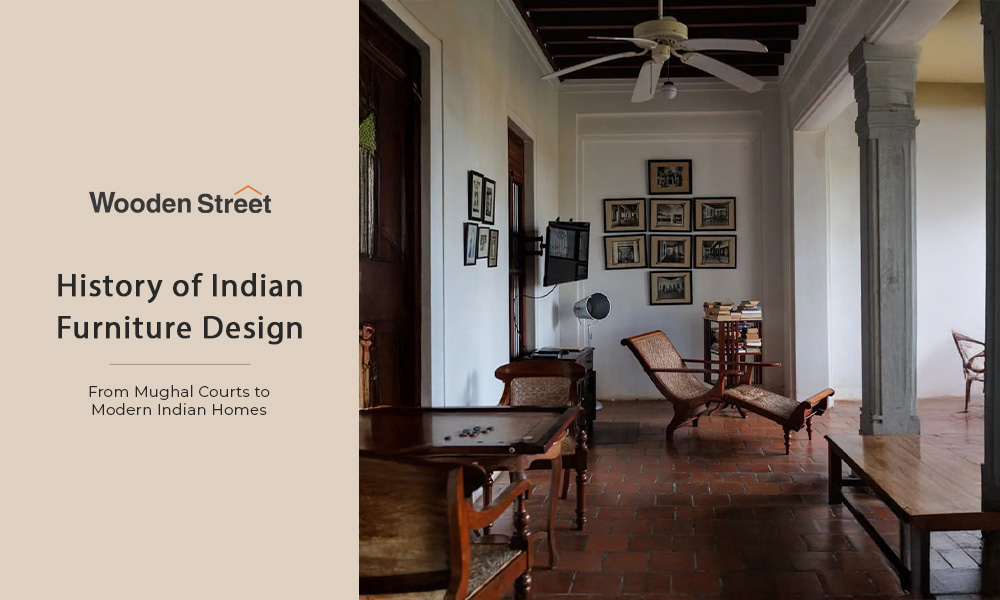
Table of Content- Why Indian Furniture Has No Single Origin Story
- Before the Mughals: What Indian Interiors Actually Looked Like
- The Mughal Period (1526–1857): When Indian Furniture Became a Statement of Power
- The Colonial Period (1600s–1947): When East Met West on Four Legs
- Post-Independence (1947–1990s): The Search for a Modern Indian Design Identity
- 1990s to 2010s: Liberalisation, Commercialisation, and the Loss of the Middle Ground
- 2015–Present: The Return to Indian Design, On Indian Terms
- The Defining Characteristics of Indian Furniture Through the Ages
Just do one thing: Go look at the furniture in your own home right now. That solid sheesham bed your parents bought when they got married. The old wooden sandook in the corner of the storeroom that nobody uses anymore but nobody can throw away either. That one carved wooden chair in the pooja room that has been there since before you were born. Now think - where did all of this come from? Who designed it? Where did the style come from? And why does Indian furniture look the way it does?
Most of us have grown up with Indian furniture all around us but nobody ever really told us the story behind it. We know that our nani's heavy wooden almirah was made of teak. We know that the carved jali work on the pooja mandir door looks like something from a temple. We know that the charpoy in the village home and the divan in the city flat feel like they come from the same family. But we never quite knew why or where all of it actually began.
So this blog is going to do exactly that. Walk you through the full history of Indian furniture design, from the time when chairs did not even exist in Indian homes, all the way to the sheesham and mango wood living rooms of today. And trust us, this is a story that is much more interesting than a history class - because it is the story of your home. Let's get started.
Why Indian Furniture Has No Single Origin Story
Before we go era by era, here is the most important thing to understand about Indian furniture history and it is something most people do not know:
- India does not have one furniture lineage. It has at least six - regional traditions, imperial styles, colonial influences, and local craft forms that all developed at the same time, in different parts of the subcontinent, often without knowing about each other
- The most surprising part of traditional Indian furniture history is that India had no dominant chair culture before Mughal rule arrived. Most of the country lived, ate, worked, and slept at floor level - on chowkis, divans, takht platforms, and woven mats. The chair as the central piece of a home is largely a post-colonial idea in India
- So Indian furniture history is not a straight line from one style to the next. It is more like a layered map - trade routes, conquests, craftsmen, climates, and communities all leaving their mark on what Indian homes looked like at different points in time
- This is what makes it so fascinating. And this is why even today, a home in Kerala looks completely different from a home in Rajasthan - the furniture traditions are that different from each other
Before the Mughals: What Indian Interiors Actually Looked Like
Let's go all the way back to the Vedic period through the Mauryan and Gupta empires, roughly 1500 BCE to 600 CE:
-
Furniture was minimal, deeply functional, and tied directly to social hierarchy - only royalty sat on raised surfaces. Everyone else sat on the floor, on mats, on woven asanas, on low platforms. This is traditional Indian furniture in its oldest, most honest form
- The three primary forms that appear again and again in ancient Sanskrit texts and temple sculptures are: the Pitha (a low wooden platform), the Asana (a seat or mat), and the Paryanka (a couch or daybed). If you look closely at the Ajanta Cave paintings from the 5th to 6th century CE or the Ellora sculptures, you can see these forms depicted in detail - and they look surprisingly similar to what you might still find in a traditional South Indian home today
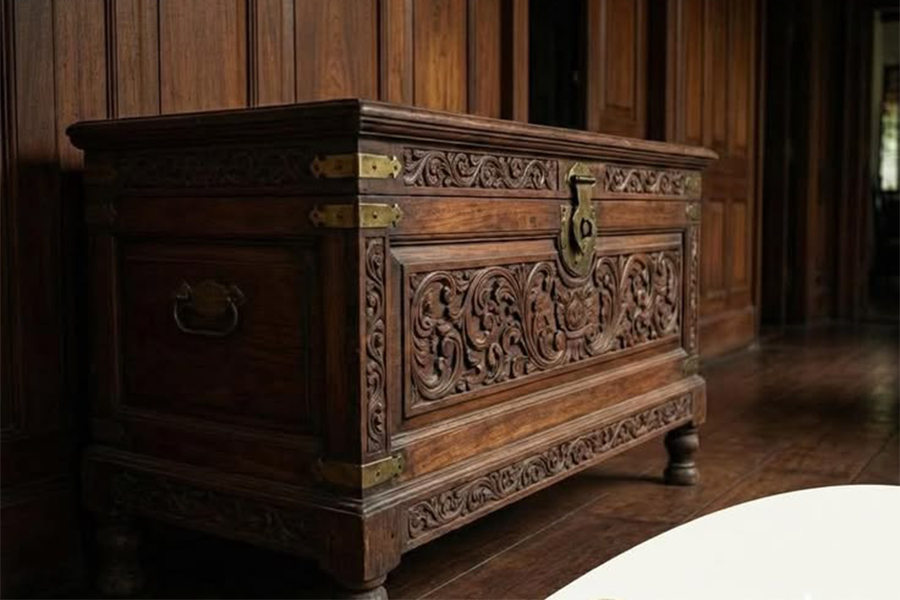
- In Jodhpur, Rajasthan and parts of Gujarat, carved wooden furniture traditions developed completely on their own - mostly for storage and ceremony. The sandook (wooden chest) and the wedding chowki are two forms that came from this tradition and are still part of Indian furniture history in a very real, daily way
- South Indian and Kerala furniture is a completely different story from North India. Kerala used teak and rosewood with joinery traditions that were more influenced by maritime trade with Southeast Asia than by anything happening in the North. The furniture of a traditional Tharavad home in Kerala and a haveli in Rajasthan are almost like furniture from two different countries - both Indian, both ancient, both beautiful, but completely different in character
The Mughal Period (1526–1857): When Indian Furniture Became a Statement of Power
This is the period that most people think of when they think of Mughal furniture - and it is the one that changed Indian furniture history the most dramatically:
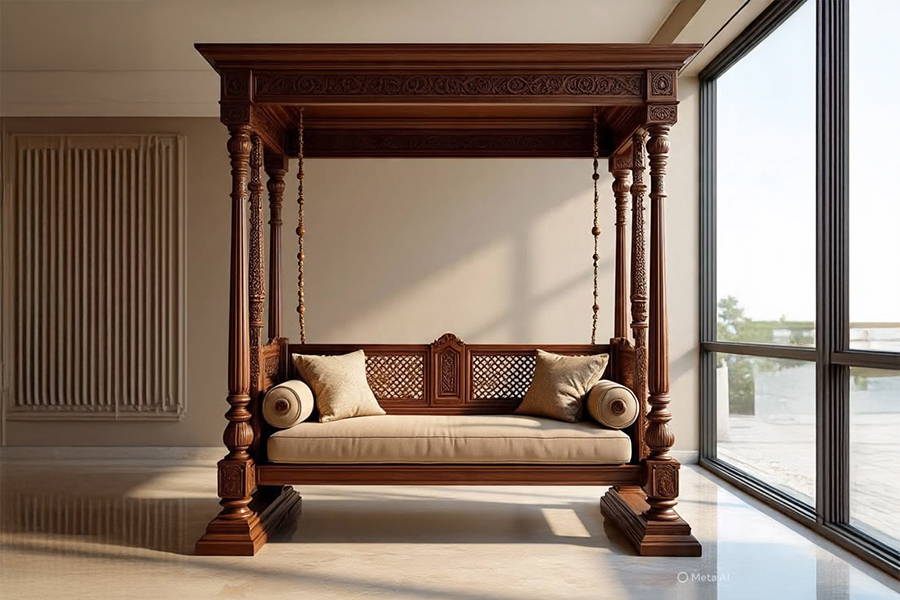
- The Mughals brought Persian and Central Asian design sensibility into Indian courts. When that met the extraordinary skill of local Indian craftsmen - the wood carvers of Rajasthan, the inlay workers of Agra, the weavers of Kashmir - it created what we now recognise as classic North Indian traditional Indian furniture
-
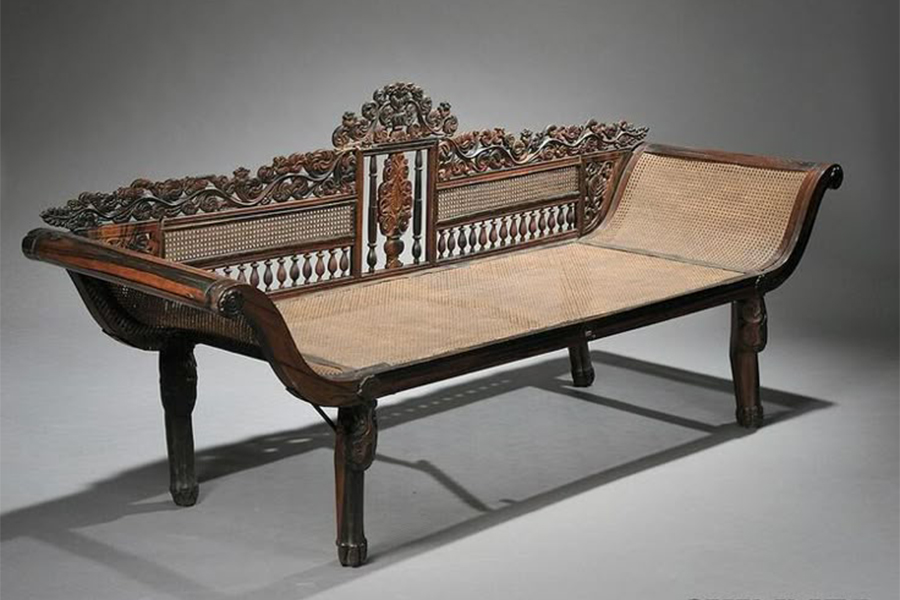
Thetakht - the throne platform, often marble-inlaid - became the centrepiece of Mughal court design. Alongside it, ornate charpoys with turned legs, and fabric-heavy seating - bolsters, toshaks, and bolster-lined floors - replaced individual chairs at court. Mughal furniture was about power expressed through surface richness, not through individual chair design
-
Thejali - latticed woodwork - became the signature Mughal furniture and design element. Used in screens, panels, and cabinet doors, it filtered light while keeping privacy. And if you look at any modern Indian wardrobe with carved panel doors, or a pooja mandir with jaali work, you are looking directly at a tradition that started in the Mughal courts. This is how deep Mughal furniture has gone into Indian homes
-
Sheesham (Indian rosewood) and teak became the preferred imperial timbers - strong enough for intricate carving, dense enough to take inlay work in ivory, bone, and semi-precious stone. This is exactly why these same woods are still the most trusted materials in Indian furniture history today
-
The pietra dura inlay technique - parchinkari - the very same method used in the Taj Mahal - appeared on furniture surfaces of the elite: table tops, cabinet doors, bed frames. The Victoria and Albert Museum in London holds one of the most significant collections of Mughal-era furniture outside India, and looking at those pieces, you can see exactly where many of today's carved Indian furniture forms came from
The Colonial Period (1600s–1947): When East Met West on Four Legs
This is the chapter of Indian furniture history that most people find genuinely surprising because the colonial period did not just impose foreign furniture on India:
- What actually happened was a conversation - sometimes an uncomfortable one - between what British and Portuguese rulers wanted and what Indian craftsmen actually knew how to do. And the result was something that belonged to neither tradition fully but was remarkable on its own terms
-
Indo-Portuguese furniture from Goa and Kerala: rosewood and teak cabinets with European baroque proportions but Indian floral carving on every surface. These pieces are still actively collected and reproduced today because that combination is genuinely unlike anything else in world furniture history
-
TheBombay Blackwood period: British officers commissioned Indian craftsmen to build European-style chairs, tables, and armoires in local materials - at a quality level that was simply impossible to get in England at the price available in India. The result was colonial Indian furniture of a standard that European buyers are still paying serious money for at auction houses like Sotheby's and Christie's
-
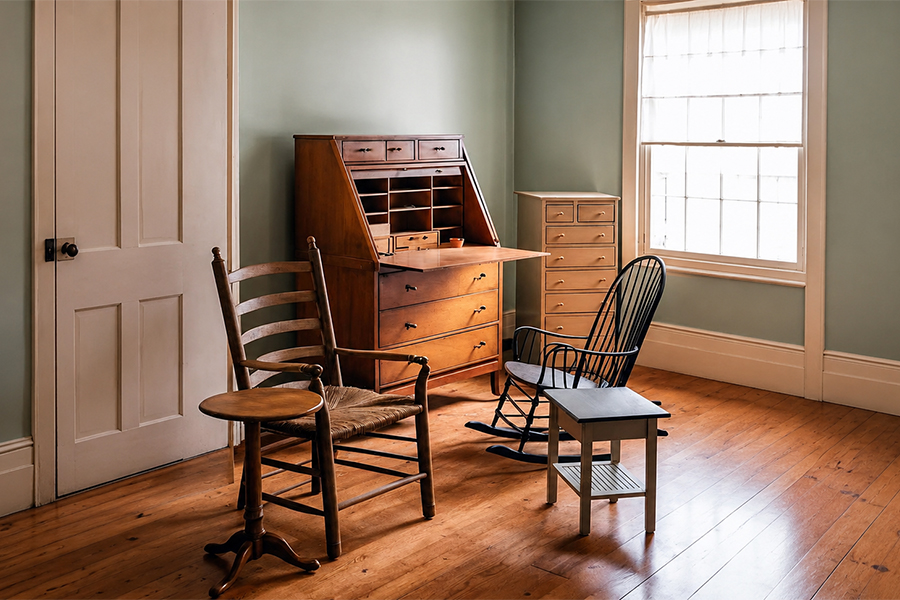
ThePlanter's Chair - also called the British India Chair - is the reclining hardwood armchair with extended leg-rest arms, designed for colonial verandah life in the Indian heat. This is one of the few furniture forms from this entire era that is still in mainstream production today. If you have ever sat on one, you know exactly why it lasted
-
Chippendale, Hepplewhite, and Sheraton European styles were reproduced in sheesham and rosewood by Indian craftsmen who quietly adapted every motif - peacocks replacing English florals, lotus replacing acanthus. The furniture looked European from across the room and completely Indian up close. This is colonial Indian furniture at its most interesting
Post-Independence (1947–1990s): The Search for a Modern Indian Design Identity
Independence in 1947 created an immediate and genuine design question that nobody had a clear answer to: what should Indian furniture look like now?
-
Two very different visions were competing in the 1950s and 60s: Le Corbusier's Chandigarh project brought European modernism wholesale into India, while the handicraft revival movement championed by figures like Pupul Jayakar and the Crafts Council of India argued for building on India's own material traditions
-
In 1958, Charles and Ray Eames visited India and produced The India Report - a foundational document that argued directly that Indian design should grow from its own material culture and not copy Western modernism. This report directly influenced the founding of NID (National Institute of Design, Ahmedabad) in 1961 - and that institution went on to shape modern Indian furniture design for decades
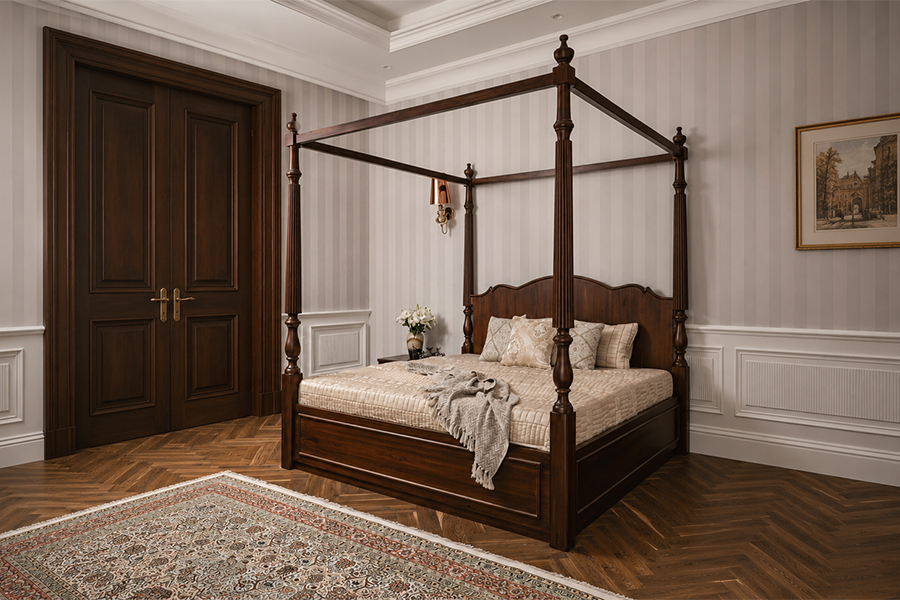
- But the practical reality for most Indian homes in this period had nothing to do with design philosophy. Affordability drove every furniture decision - and this is where the steel almirah, the Godrej cupboard, and the wooden divan became the dominant domestic furniture forms of an entire generation. If you grew up in India in the 70s or 80s, these pieces are your furniture history as much as any Mughal takht
-
Regional craft traditions - Rajasthani hand-painted furniture, Kashmiri walnut carving, Saharanpur woodwork - continued quietly through this period, mostly serving the export market rather than urban Indian homes, which were busy discovering affordability and practicality
1990s to 2010s: Liberalisation, Commercialisation, and the Loss of the Middle Ground
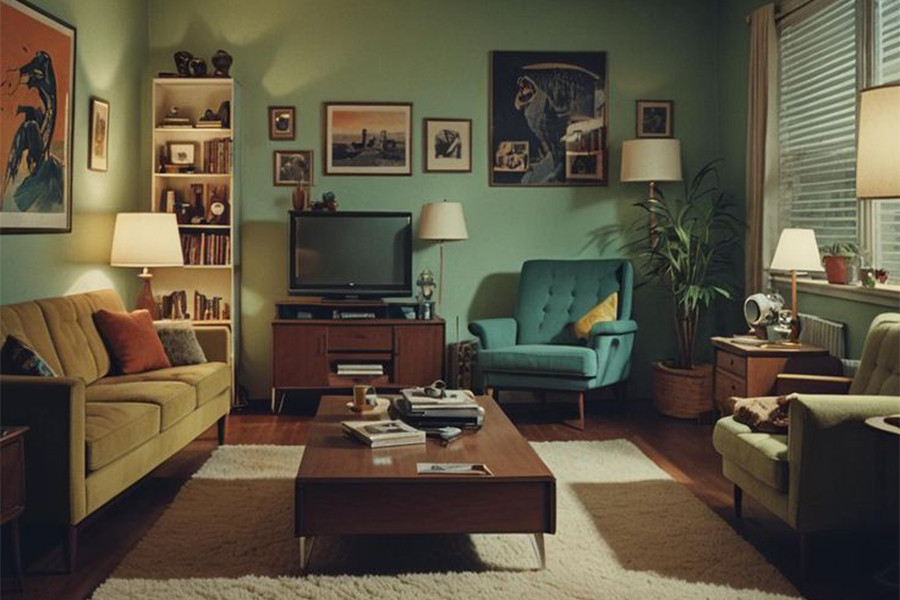
Economic liberalisation in 1991 changed Indian furniture history faster than any other single event since colonial rule:
- The organised retail furniture market grew from nearly nothing to ₹1.5 lakh crore by the 2010s - and flat-pack, engineered wood furniture entered urban Indian homes at a scale that traditional craftsmen in Jodhpur, Saharanpur, and Rajkot could not compete with on price
-
The export paradox of this period is genuinely ironic: Indian handcrafted furniture - sheesham, mango wood, reclaimed wood - became hugely sought after in European and American markets through brands like Made.com and West Elm, even as it was losing ground in its own domestic market to cheaper, faster alternatives
-
Urban Indian interior design in the 2000s went through a phase of very deliberate Western minimalism - white walls, light wood, glass and chrome. It was a conscious decision to move away from what was being called "old-fashioned" Indian heaviness. And for a while, the heavy sheesham bed and the carved wooden wardrobe felt unfashionable in the very country that invented them
2015–Present: The Return to Indian Design, On Indian Terms
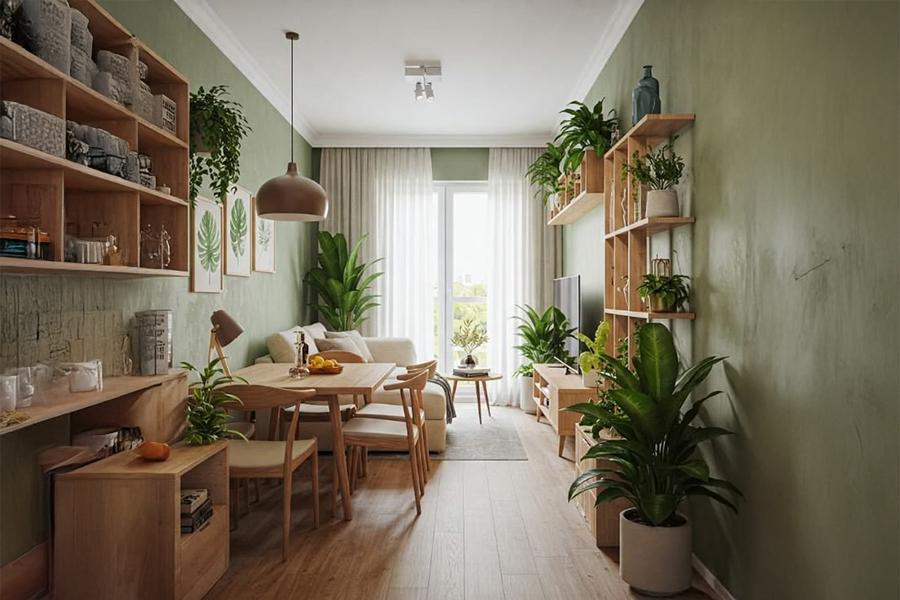
And then something shifted and this is the most exciting part of modern Indian furniture design history:
- A new generation of Indian designers, buyers, and studio makers reclaimed traditional craft - not as nostalgia for what used to be, but as a very deliberate, considered design choice
- Design studios like Phantom Hands in Bangalore, Tiipoi, and Nicobar began reinterpreting traditional Indian forms in completely contemporary ways - studio furniture with a documented craft background that could stand alongside anything produced in Scandinavia or Japan
- Urban buyers started asking the same questions about furniture that they had started asking about food: where did this wood come from, which community made this, what technique was used to carve it? Provenance became part of the purchase
- Material preference swung back decisively to solid wood - sheesham, mango, teak, and acacia are driving the premium domestic furniture market right now as buyers who bought engineered wood in the 2000s experienced its real durability limitations and came back to what their parents already knew
- The handmade and the imperfect became premium signals - hand-carved marks, natural wood grain variation, and the small irregularities that only an artisan's hand can make are now the most valued surface qualities in modern Indian furniture. Mass production cannot replicate them, and buyers know it
- Wooden Street's solid wood furniture collection is part of exactly this moment - sheesham and mango wood pieces that carry the warmth and durability of India's oldest furniture materials, built for the modern Indian home that finally knows what it wants again
The Defining Characteristics of Indian Furniture Through the Ages
| Era |
Dominant Material |
Signature Form |
Design Influence |
| Pre-Mughal |
Teak and local hardwoods from regional forests |
Chowki, paryanka, sandook - floor-level living, storage-first thinking |
Regional traditions, Vedic culture, temple craft |
| Mughal |
Sheesham with marble, ivory, and stone inlay |
Takht, jali screen, ornate carved cabinet - richness as power |
Persian and Central Asian design meeting Indian craft skill |
| Colonial |
Rosewood and teak worked to European proportions |
Planter's chair, almirah, Anglo-Indian cabinet - hybrid forms that belonged to both worlds |
European silhouette with Indian carving on every surface |
| Post-Independence |
Steel, solid wood, and cane - affordable, durable, practical |
Divan, Godrej steel almirah, craft revival pieces for export |
Modernist philosophy and craft preservation in parallel |
| Contemporary |
Sheesham, mango wood, reclaimed wood |
Studio furniture, artisan-designed pieces, solid wood beds and wardrobes |
Global design sensibility with Indian materials and craft at the centre |
Conclusion
So the next time you run your hand along the carved edge of a sheesham bed, or spot the jali work on a wardrobe door, or notice that the old sandook in the corner has a joinery style you have never seen anywhere else you will know where it all came from. None of it happened randomly. Every form, every material, every carving tradition in Indian furniture history has a reason behind it, a period that shaped it, and a community that kept it alive.
Indian furniture has survived Mughal courts, colonial verandahs, post-independence steel almirahs, and flat-pack liberalisation. And right now, in 2025, it is more valued, more sought after, and more honestly itself than it has been in decades. Because the best thing about traditional Indian furniture is that it was never just about looks. It was always about something that lasts - the wood, the craft, the story, and the home it lives in.
We will be back with the next blog soon. Till then, stay tuned!
Image Source: Pinterest, Google, and Wooden Street
FAQs
Q
What is the history of furniture in India?
A
Indian furniture history goes back to the Vedic period, where floor-level living on chowkis, asanas, and paryankas was the norm across most of the country. From there it moved through the richness of Mughal court design, the hybrid forms of the colonial period, the affordability-first post-independence era, and finally the solid wood revival happening in Indian homes right now. It is not one story - it is many stories happening at the same time in different parts of the country, which is what makes it so interesting.
Q
What type of furniture did the Mughals use?
A
Mughal furniture was all about surface richness and craftsmanship as a display of power. The takht (throne platform), ornate charpoys with turned legs, jali-panelled screens and cabinets, and floor-level seating with bolsters and toshaks were the key Mughal furniture forms. Sheesham wood with ivory, bone, and stone inlay was the preferred material - and the pietra dura inlay technique used in the Taj Mahal also appeared on the finest Mughal furniture pieces.
Q
What is Anglo-Indian furniture?
A
Anglo-Indian furniture is a collector's category for the hybrid furniture produced during the British colonial period - specifically, European silhouettes like Chippendale chairs and Hepplewhite tables made by Indian craftsmen in sheesham and Indian rosewood, with Indian carving motifs replacing the original European decorative elements. Peacocks replaced English florals, lotus replaced acanthus. These pieces are actively auctioned at Sotheby's and Christie's and are considered a distinct and highly valued tradition in colonial Indian furniture history.
Q
What wood has been used in Indian furniture historically?
A
The dominant woods across Indian furniture history are teak, sheesham (Indian rosewood), mango wood, and in South India, rosewood and jackwood. Sheesham became the signature imperial timber under the Mughals for its density and its ability to take fine carving and inlay. Teak was preferred in South India and coastal regions for its resistance to moisture. Today, sheesham and mango wood are the two most widely used materials in Indian solid wood furniture, and both carry a direct connection to centuries of Indian craft tradition.
Q
Why is Indian furniture known for its carving?
A
Because carving in India was never purely decorative - it carried meaning. Lotus motifs, peacock forms, geometric jaali patterns, and deity carvings all had specific purposes in specific contexts, whether religious, royal, or domestic. The tradition of intricate wood carving in regions like Rajasthan, Gujarat, and Kashmir developed over centuries because the craftsmen were also the storytellers. And that tradition is why carved Indian furniture still reads as something genuinely different from anything produced anywhere else in the world.